In February this year, 3D Printing Industry compiled predictions from more than 60 industry executives: CEOs of Carbon, HP Additive Manufacturing, Stratasys, EOS, directors from Wohlers Associates. The reading was unanimous: 3D printing has left the promise phase and entered the execution phase. And the Fortune Business Insights numbers confirm it: we go from US$ 30.55 billion in 2025 to US$ 168.93 billion in 2033, almost 5x in eight years.
The numbers that moved the goalposts
Growing 24% a year for nearly a decade is not a trend: it is leverage. But the detail that changes everything is where that money lands.
- US$ 30.55B (2025) → US$ 168.93B (2033), 23.9% CAGR (Fortune Business Insights).
- Hardware still leads with 62.6% of the market, but it is precisely the segment with compressing margins.
- Industrial printers account for 51.66% of revenue in 2026, driven by healthcare, automotive and aerospace.
- Metal additive manufacturing left isolated pilots behind in 2025 and entered real industrial production.
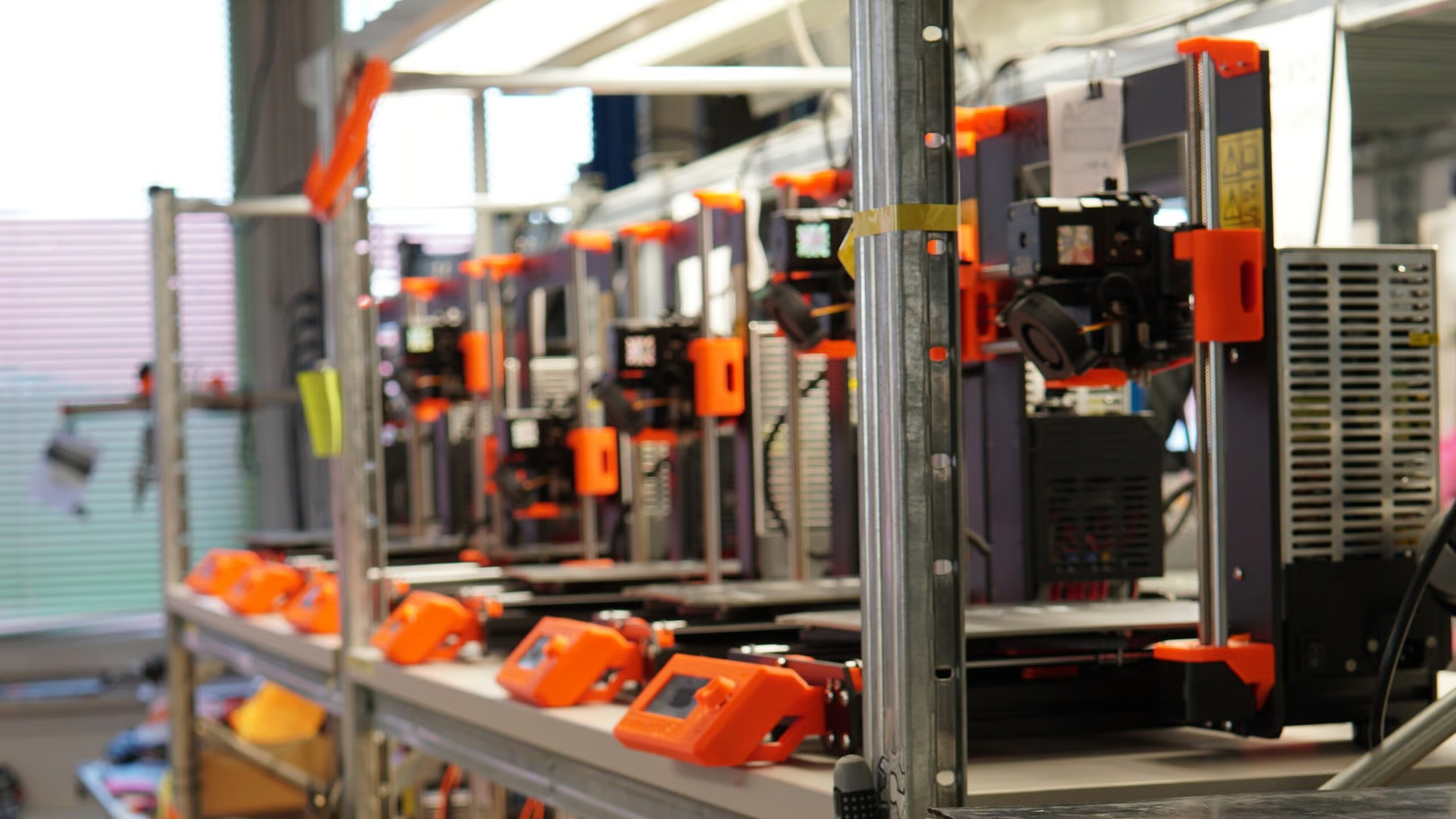
- Western print farms exploded with Chinese machines 30-50% cheaper (Bambu, Creality, Anycubic).
format_quoteSuccess in 2026 will not be defined by how many printers you have installed, but by how much you actually use them.
— Phil DeSimone, CEO of Carbon
In other words: owning a machine has become a commodity. Operating with method is the asset. And that sentence reads differently for each profile in the industry. Let’s break it down.
Haven’t started yet: the window is open, but it closes
If your question is "is it still worth getting in?", the industry itself answers you. When a market quintuples in 8 years, any move within that window is still early. The risk is not entering: it is entering late and fighting for space with players who already have a well-oiled operation.
- Cheapest equipment in history: Bambu, Creality and Anycubic machines deliver industrial quality at 30-50% of the price of Western brands.
- Reliable, available supplies: premium PLA, industrial PETG and 4K resins with consistent quality and an active national marketplace.
- Real demand spread across niches: collectibles, RPG miniatures, decoration, spare parts, dental, eyewear.
- Shorter learning curve: tutorials, ready-made profiles per filament brand, active Discord and WhatsApp communities.
What separates those who will ride this wave from those who will watch: a pricing method from the very first part sold. Printing pretty is easy. Knowing whether you are at a profit or a loss is not. That is why we offer the free EiPrint calculator, no signup, so you can get the price of your first part right before you even buy your first printer.
For beginners: a print farm is the new standard and it demands management
If you already have 1 or 2 printers running and want to grow, your business’ next turn is the farm: multiple machines operating in parallel. The experts are blunt: the desktop/prosumer segment grows fast, but only those operating with SOP (standard operating procedure) survive. Without standardization, a farm becomes chaos and the profit evaporates.
- Standardize material: 3 to 5 filament profiles, not 20. Catalog temperature, speed and retraction for each and always use the same ones.
- Measure failure per machine: your "champion" and "problem" printers need documented numbers, not gut feeling.
- Sync registrations across devices: a quote that leaves your phone must be in the same place as the desktop history, in real time.
- Register depreciation: nozzles, FEPs, build plates, UV lamps, they all have a service life. Whoever doesn’t charge for it, pays out of pocket.
- Automate post-processing: sanding, painting and packing is the new bottleneck, not printing. Reserve a dedicated schedule for it.
This is exactly the stage where EiPrint Premium gains traction: unlimited printer and filament profiles, real-time Android ↔ Web sync and per-machine reporting. Not a luxury: it is what separates a professional operation from a paid hobby.
For the experienced: where the real margin is in 2026
Bureau or studio with 5+ machines and an established flow: the new 2026 margin is not in buying another printer. It is in three fronts the Carbon, EOS and HP executives converged on, plus a fourth gaining traction in Brazil.
- Mature applications: dental, eyewear and footwear stopped being a "marketing gimmick" and became at-scale production. High ticket, high margin, recurring clients.
- Automated post-processing: manual finishing became the industry bottleneck. Whoever industrializes sanding, painting and UV curing scales without pain.
- Software-first: hardware margins are compressing globally. The players capturing value are the ones with recurring management: reports, AI quoting, multi-printer, production dashboards.
- Distributed, on-demand manufacturing: serving small custom orders within 24h is the new competitive edge, and it requires Octoprint/Klipper integration for smart queues.
format_quoteHardware margins are compressing. Software-first players are building recurring revenue models: that is where the real value of the sector is moving.
— 3D Printing Industry analysis of 2026
Anyone still running a bureau on a spreadsheet in 2026 is leaving margin on the table. The whole industry signals the same direction: the future belongs to those with real-time data, not to those with more idle printers.
The common denominator: measure before you print
Beginner, intermediate or professional bureau: the recommendation of the 60 executives converges on a single word: utilization. It is the metric that defines who captures the boom. And utilization only exists if you measure every part, every filament, every machine hour.
That is exactly the method EiPrint codifies. It starts with a free calculator (no signup, no limits), unlocks the Android app to standardize operations and, on Premium, syncs everything to the cloud with unlimited profiles and history. The method is the same, from hobbyist to bureau: only the scale of the data changes.
The 3D sector will double twice in the next 8 years. The question is not whether it will happen. It is whether you will be measuring when it does.
Sources
- 3D Printing Industry: "The Future of 3D Printing: Additive Manufacturing Expert Forecasts for 2026", with Phil DeSimone (Carbon), François Minec (HP AM), Rich Garrity (Stratasys), Glynn Fletcher (EOS), Mahdi Jamshid (Wohlers Associates) and 55+ industry executives.
- Fortune Business Insights: "3D Printing Market Size, Share & Industry Trends Report 2034" (US$ 30.55B → US$ 168.93B, 23.9% CAGR).
- Grand View Research: "3D Printing Market Size And Share Industry Report 2033".
- SkyQuest: "3D Printing Market Analysis, Size, and Global Forecast 2026-2033".
- GMI: "Industrial 3D Printer Market Statistics 2026-2035 Report".